Wheel Alignment in Boca Raton, FL
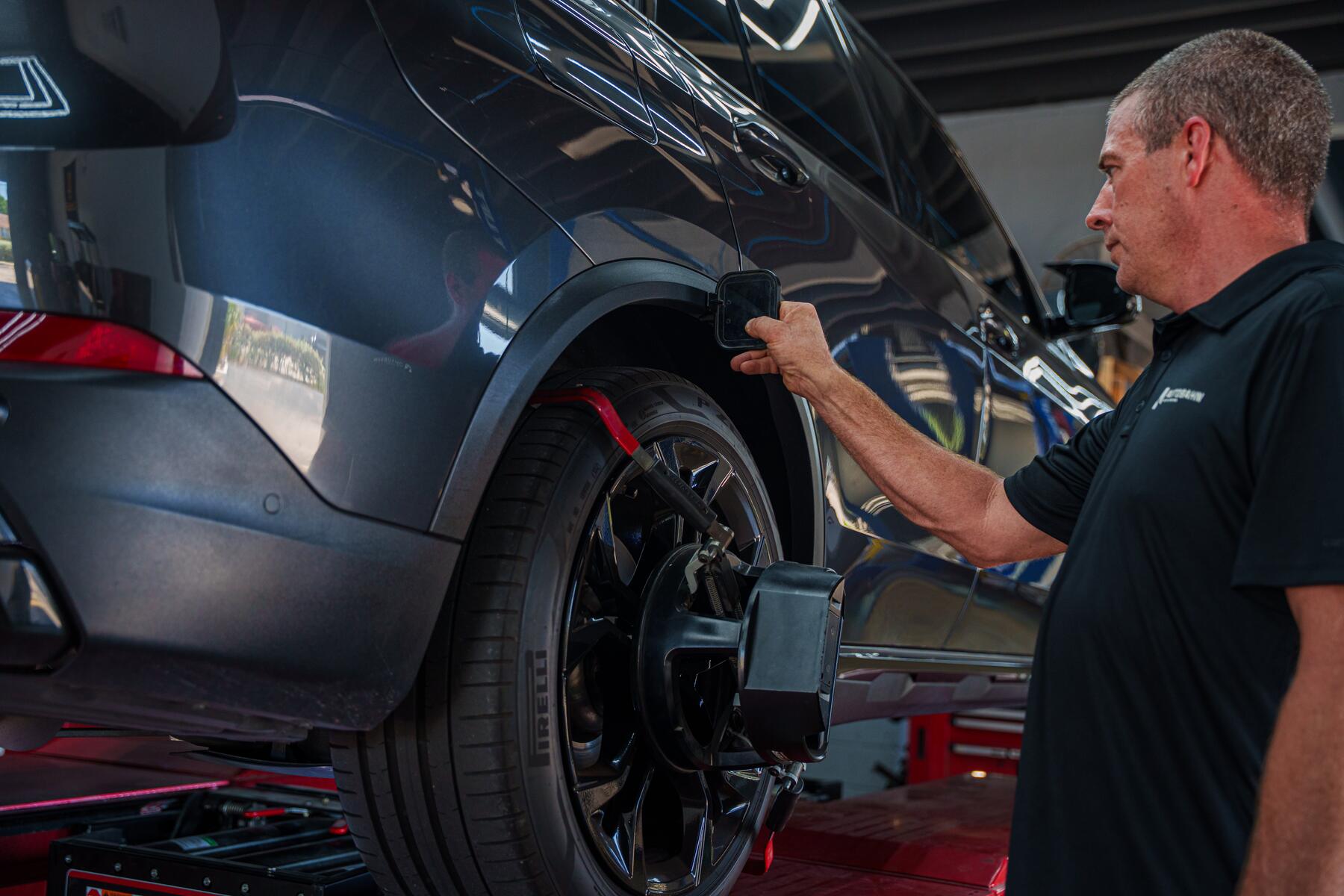
Four wheels measured on our Hunter rack, camber, caster and toe set to your car’s own specification, and the before and after readings printed for you.
An alignment is a measurement, not an opinion
Every car leaves the factory with angles it was designed around, and a set of tires is the most expensive thing those angles quietly protect.
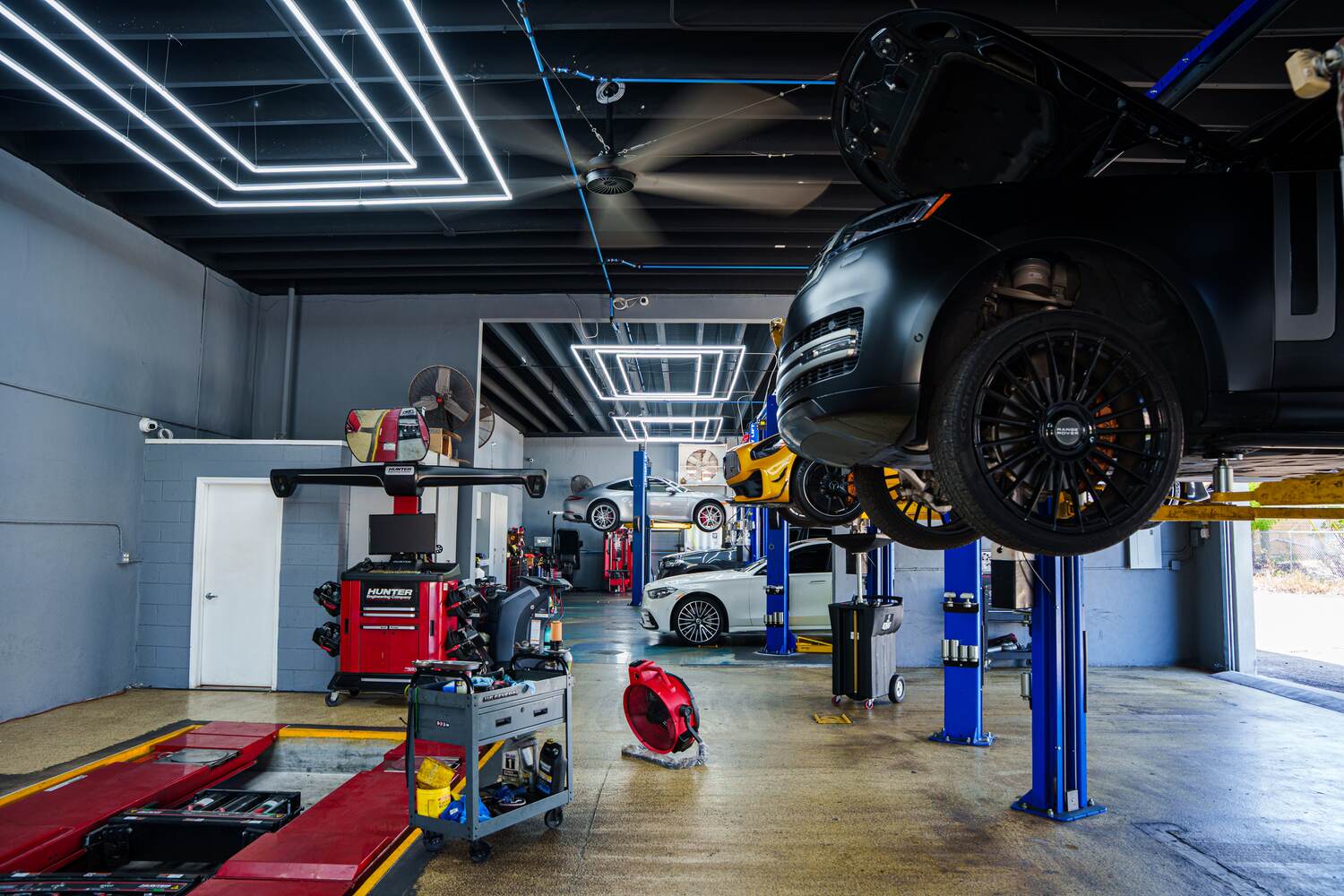
We put the car on our Hunter alignment rack, measure all four wheels against your manufacturer’s own specification, and adjust what is out. You get the readings before and after, so you can see what was wrong and what it is now. On a European car this is not a formality, because most of them have rear adjustment the cheap version of this job never touches.
What a four-wheel alignment here includes
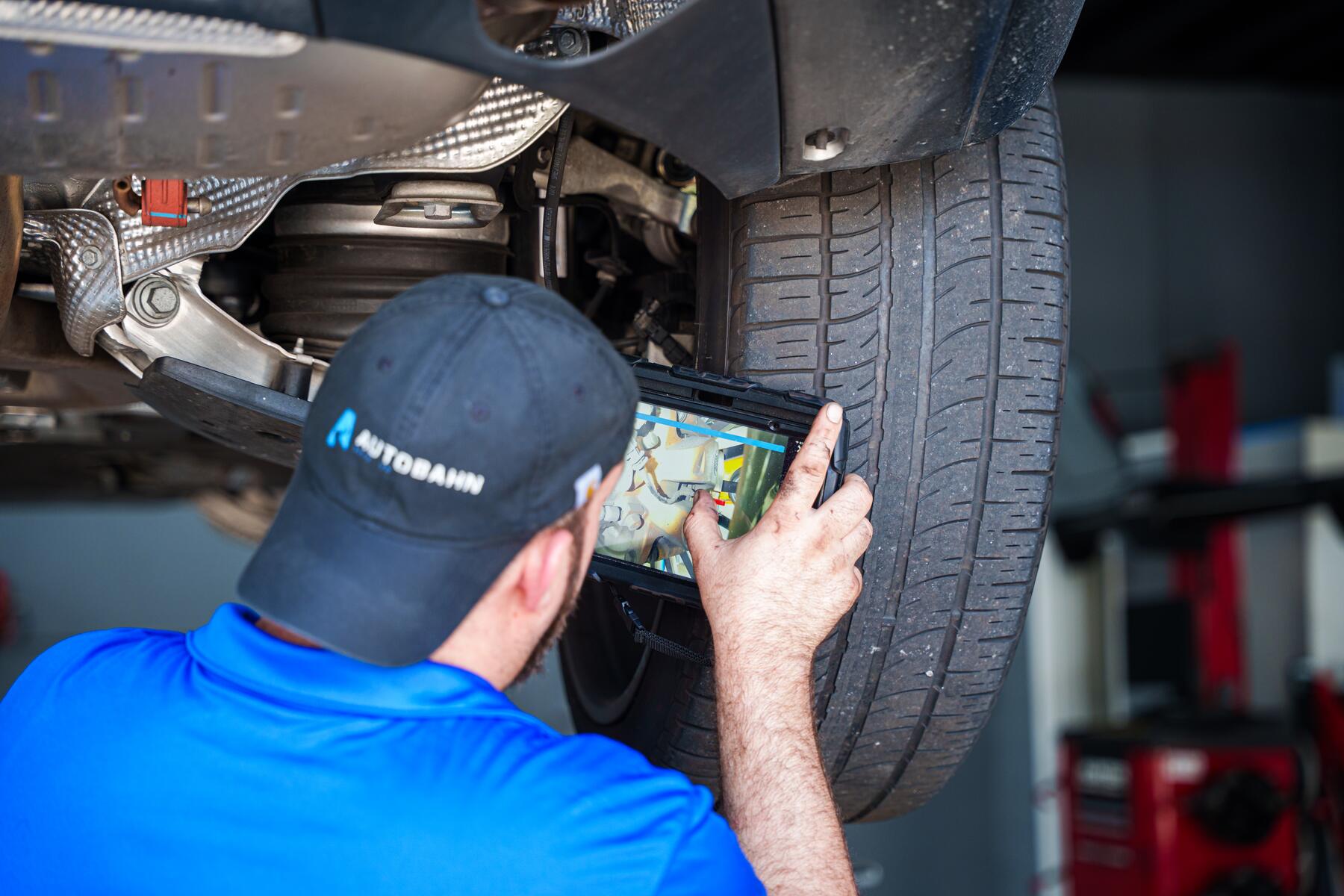
A pre-check of tires, suspension and steering components first, because there is no point setting angles on a worn bushing or a loose tie rod. Then ride height confirmed, all four wheels measured, camber, caster, toe and thrust angle compared against factory specification, adjustments made where the car allows them, the steering angle sensor reset where the car needs it, and a road test afterwards. You leave with the printout.
And what we will tell you honestly
If the readings come back inside specification, we will tell you that and hand you the sheet that proves it. If the car cannot be brought into specification because something underneath is worn or bent, we will show you the part rather than dialing the toe around it, because an alignment set on top of a worn component will not hold and you will be back.
What brings a car in for alignment
- Pulling to one side, the obvious one, though a pull can also be a tire, a brake or a suspension fault, which is why we check before we adjust.
- An off-center steering wheel, straight road, wheel sitting at an angle. That is usually toe split unevenly between the two front wheels.
- Tires wearing on one edge, which is camber or toe, and which will eat a set of European tires long before the tread is legally done.
- After a pothole or a curb strike, which South Florida provides generously, and which can knock a wheel out of specification in one hit.
- After suspension or steering work, because control arms, tie rods, struts and subframe bolts all move the angles when they are replaced.
- After new tires or lowering springs, since changing ride height changes camber and toe on almost every European platform.
What separates an alignment done properly
Alignment is where a lot of shops sell the word and skip the work, because the customer cannot see the difference on the way out of the parking lot.
Four wheels, not two
A front-toe-only alignment is faster, cheaper and mostly pointless on a modern European car. Nearly all of them have adjustable rear toe, and several have adjustable rear camber. If the rear is out, the car is driving slightly crab-wise down the road, the steering wheel will not sit straight no matter what you do to the front, and the rear tires will wear anyway. Thrust angle is the number that catches it, and you only get it by measuring all four.
Ride height comes before the numbers
Camber and toe change as the suspension moves, so the car has to be at its correct ride height before anything is measured. On air suspension, which means a lot of Range Rovers, Airmatic-equipped Mercedes and plenty of Porsches and Audis, that means putting the system into the right mode first rather than measuring whatever height it happened to settle at. Get this wrong and every number after it is wrong too.
The car has to be checked before it is adjusted
Worn control arm bushings, tired tie rod ends, a bad wheel bearing or unequal tire pressures will all move the readings. Adjusting to compensate for a worn part gives you a car that measures perfectly on the rack and drifts back out within a few hundred miles. We inspect first, photograph anything we find, and tell you before we start turning anything.
The electronics have to agree with the geometry
Once the front wheels are set, the steering angle sensor needs to know where straight ahead now is. Left alone, that is how a car comes back with a stability control or lane keeping light on after an alignment that was otherwise done correctly. We reset it with a factory-level scan tool as part of the job, and if your car also needs a forward camera recalibrated afterwards we will tell you that before you book rather than after.
What you’re paying for, line by line
The parts of this job that never appear on an invoice are the ones that decide whether it holds.
All four, including rear toe and thrust angle
Your model’s own factory figures, on the rack
Suspension, steering and tires checked first
Set correctly first, air suspension included
Corrected before measuring, because they change the numbers
Reset with a scan tool, so the assistance systems agree
Before and after readings, printed and yours to keep
Road tested, because the wheel either sits straight or it does not
From drop-off to drive-out
Five steps, and you know what you are getting at the end of each one.
Book it, or just drop it off
Call, text, or book online. After-hours drop-off if that suits you better, and a free local shuttle so you are not sitting here waiting on us.
We look before we quote
Tires, pressures, suspension and steering checked and photographed first, then the car goes on the rack for a full set of readings against factory specification.
You get it in writing first
An itemized estimate with parts and labor separated, and what can wait flagged separately from what cannot. Nothing is touched until you approve it.
The work, done to specification
Camber, caster and toe adjusted where the car allows it, thrust angle brought back square, the steering angle sensor reset, and a road test before you get the keys.
Six years, unlimited miles
Qualifying repairs carry our parts and labor warranty, it transfers if you sell the vehicle, and every visit is logged so the service history stays intact.
What it costs
A four-wheel alignment is priced on the car and on what it takes to adjust it. A vehicle with straightforward rear adjustment and one that needs eccentric bolts freed off, a subframe shifted, or an air suspension system put into service mode before anything can be measured are not the same amount of work, and quoting one number for both means somebody is rounding in their own favour.
So we quote your car. If the pre-check finds a worn component that has to be replaced first, you will hear that as a separate line with a price on it, not as a surprise once the car is already on the rack. And if the readings turn out to be inside specification, we would rather tell you that and hand you the sheet.

Backed for 6 years / unlimited miles
Parts and labor, on every qualifying repair, and it transfers to the next owner if you sell the vehicle.
Wheel Alignment FAQs
There is no fixed interval, because alignment goes out from events rather than from mileage. Once a year is a sensible check on South Florida roads, and it is worth doing after new tires, after any suspension or steering work, and after a pothole or curb strike hard enough to make you wince. If the car tracks straight and the tires are wearing evenly, you are probably fine.
Easily. Toe can be well out of specification with the car still tracking straight, because the two front wheels are fighting each other symmetrically. You will not feel it, but the tires will show it as feathered or inside-edge wear. That is the expensive version of being out of alignment, because the first symptom is a set of tires.
On a European car, four. Almost all of them have adjustable rear toe, and if the rear is out, the front cannot be set correctly around it. You would end up with a straight steering wheel on a car that is still driving slightly sideways, and the rear tires would keep wearing. Measuring all four is also the only way to see the thrust angle.
No, and they solve different symptoms. Balancing corrects a vibration caused by weight distribution in the wheel and tire. Rotation moves tires around the car to even out wear. Alignment sets the angles the wheels sit at relative to the car and the road. A vibration at speed is usually balance. Uneven wear or a car that will not track straight is usually alignment. We cover the difference in more detail in tire rotation vs wheel alignment.
An alignment is an adjustment rather than a part, so it is not a warranty item in the way a repair is. What we will do is stand behind the work: if the car leaves here in specification and the readings drift because of something we should have caught, bring it back. Any suspension or steering parts we replace as part of getting it there are qualifying repairs and do carry the six-year, unlimited-mile coverage.